

Stari Hrast Winery – Wine with a Sense of Place in Šumadija
Just fifteen kilometres from Kragujevac, on a plateau above the village of Žirovnica, lies one of those places that help explain why Šumadija has increasingly come to be recognised as one of Serbia’s most promising wine regions.
Stari Hrast Winery is neither a large industrial producer nor does it aspire to become one. Its strength lies precisely in the opposite approach: a family estate, its own vineyards and orchards, clearly defined provenance and a close connection between the wine and the landscape from which it comes.
Overlooking the vineyards stands the ancient oak tree after which the winery was named. More than two centuries old, it has become a natural symbol of the estate. Beneath its canopy still stands an old vineyard house, locally known as a trla.
It is an image that may appear almost designed for a wine label, yet its importance goes much deeper. It is a reminder that viticulture and fruit growing in this part of Šumadija did not begin with the recent development of Serbian wine tourism. They belong to a much longer relationship between families, agriculture and the land.
The Stevanović family estate is rooted in several generations of fruit growing and viticulture, while the modern development of its vineyards intensified towards the end of the first decade of this century. The winery originally operated under the name Podrum Stevanović before adopting the name Stari Hrast – “The Old Oak” – in 2014.
That connection between old and new is perhaps the best way to understand what has been happening in Šumadija’s wine scene over the past two decades.
Tradition alone is no longer enough.
Contemporary winemaking demands knowledge, control in the vineyard, technological precision and an understanding of the market. At the same time, the most interesting wineries are trying to preserve something that large-scale industrial production can easily lose – a sense of place.
The vineyards of Stari Hrast cover around ten hectares on sites above Žirovnica, within the Šumadija and Kragujevac wine-growing area. They are planted primarily with internationally recognised varieties such as Sauvignon Blanc, Chardonnay, Merlot and Cabernet Sauvignon, while the wines are produced from grapes grown on the estate itself.
Having control over the entire process, from vineyard to cellar, allows the winery to build the character of its wines not only through winemaking techniques, but through the qualities of the vineyard itself.
And this is more important than it may initially seem.
Today, almost any serious wine-producing country can make a technically correct Chardonnay, Sauvignon Blanc or Merlot. The real question is no longer simply whether a wine is good.
The question is: does it possess something that allows us to recognise where it comes from?
That is where the serious conversation about terroir begins, and Šumadija is only now rediscovering how much potential it has to tell that story.
The location of the Stari Hrast vineyards on an open plateau, together with the characteristics of the soil and the movement of air from the surrounding Šumadija hills, provides the basis for wines with a distinctive varietal character. With the whites, the emphasis is on freshness and aromatic expression, while the red varieties have the conditions to develop greater structure and depth.
The winery is also certified for the production of wines bearing the geographical indication “Šumadija”, formally connecting its wines with the wine-growing region to which they belong.
Among the labels that have helped shape the identity of the winery is its Sauvignon Blanc, characterised by freshness and an expressive aromatic profile, with herbal, citrus and mineral notes.
The Chardonnay takes a somewhat fuller approach. Made from grapes grown in the estate’s vineyards in Žirovnica, part of its character is developed through contact with French oak, adding greater structure and subtle spicy notes to the fruit.
Among the reds, Merlot occupies a particularly important place. Judging by the wines produced by the estate over the years, the variety has adapted particularly well to the vineyard sites around Žirovnica.
Alongside varietal Merlot, the winery also produces the classic combination of Cabernet Sauvignon and Merlot. In selected Merlot bottlings, carefully chosen grapes and extended ageing in wood move the wine beyond its primary fruit character towards more complex expressions of cherry, raspberry, vanilla, dark chocolate and spice.
But the story of Stari Hrast does not end in the vineyard.
The Stevanović family also has a long tradition of fruit growing, with the estate encompassing approximately fifteen hectares of orchards. Plums, pears, apricots and quinces provide the basis for fruit brandies, bringing together two traditions deeply embedded in the gastronomic culture of Šumadija – wine and rakija.

It is precisely this combination that gives the estate potential extending well beyond the production of beverages.
Today’s traveller increasingly wants more than simply to buy a bottle.
They want to see the vineyard, meet the people behind the wine, understand how it is produced, taste local food and connect what is in the glass with the landscape around them.
This is why small and medium-sized family wineries are particularly important for the development of wine tourism. They can still provide something that becomes increasingly difficult as production grows: a direct relationship between the product, the people and the place.
Stari Hrast already has a strong foundation for precisely this kind of experience.
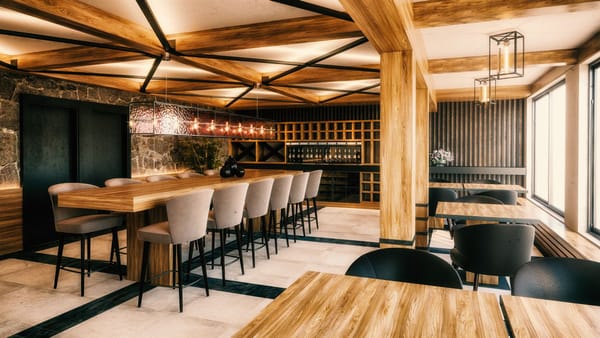
Visitors can discover the vineyards, orchards and cellar and take part in tastings of wines and rakija accompanied by local food. Its tasting room can accommodate organised groups of around fifty guests, making the estate a natural stop along the wine routes of central Serbia.
For Šumadija, this aspect of the story may ultimately be just as important as the quality of the wine itself.
A wine region is not created simply because a certain number of vineyards exist within a particular geographical area.
There needs to be a connection between wineries, gastronomy, hotels, restaurants, local producers and the broader tourism offer.
A visitor arriving in Kragujevac, Topola, Aranđelovac or elsewhere in Šumadija should be able to recognise where they are throughout their stay – through the wine served in a restaurant, the rakija offered as an aperitif, the local cheese, meat, fruit and other products that originate in the surrounding area.
In this sense, wineries such as Stari Hrast are more than wine producers.
They become part of the identity of the destination itself.
Šumadija has a considerably stronger wine scene today than it did twenty years ago. Serious wineries have emerged, vineyards have been renewed and expanded, production standards have risen, and Serbian wines increasingly occupy the place they deserve in quality hotels and restaurants.
The next step, however, must be to connect wine with the broader gastronomic identity of the region.
There is little point in describing Šumadija as a wine region if guests staying in a local hotel or dining in a local restaurant have to specifically ask for a wine produced nearby.
Local wine should be a natural part of the wine list, the waiter’s recommendation and the pairing offered with regional dishes.
The same applies to rakija.
Only when products originating from the immediate surroundings become an entirely normal part of a high-quality hospitality offer can we begin to speak of a truly developed gastronomic identity.
Stari Hrast is a good example of how straightforward such a story can be when it has genuine foundations.
There is land from which the grapes come. There is a family working that land. There are vineyards and a cellar. There is an oak tree that has witnessed several generations before the present owners. And finally, there is a bottle that carries a part of that story beyond the estate.
For that reason, the value of a winery should not be measured solely by the number of bottles it produces or the number of labels in its portfolio.
A much more important question is whether it succeeds in preserving the connection between the product and the place from which that product comes.
At Stari Hrast, that connection is visible almost immediately – from the vineyards on the plateau above Žirovnica and the centuries-old oak that has become the symbol of the estate, to the wines and rakija that carry the character of this part of Serbia.
And perhaps that is also the essence of the emerging wine identity of Šumadija.
Its future does not lie in attempting to imitate the world’s great wine regions, but in using its own land, knowledge and traditions to create something strong enough to give people a reason to come here.
Because great wine can be made in many places. The wines that truly matter are the ones that can tell you where you are.
Autor
What's Next?
Why Are We Still Ashamed of Our Culinary Heritage?
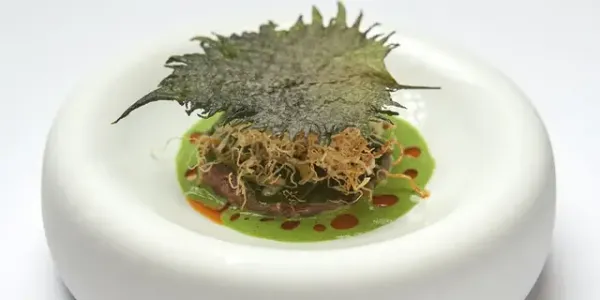
Šumadija has the products, the tradition and the culture of hospitality, but it still lacks a clear gastronomic direction capable of transforming its local cuisine into a serious tourism product. Šumadija does not have a problem with its culinary heritage. It has a problem with the way it relates to that heritage. This is perhaps the simplest way to describe the position in which one of Serbia’s richest gastronomic regions finds itself today. We have the products, the traditions, the climate an
Stara Srbija Tavern – More Than a Century of Kragujevac’s Kafana Tradition
In the very heart of Kragujevac, on Karađorđeva Street, stands a place that is far more than simply a restaurant. Stara Srbija belongs to that increasingly rare tradition of Serbian kafanas – places where history is not preserved only in old photographs and stories on the walls, but is still felt in conversations around the table, in the aroma of traditional food and in an atmosphere that recalls a time when the kafana was one of the most important institutions of urban life. The roots of Stara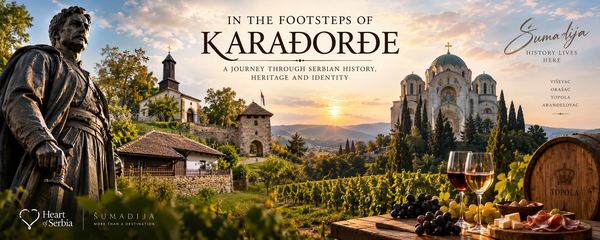
In the Footsteps of Karađorđe – A Journey Through Serbian History, Heritage and Identity
Set out through the heart of Šumadija on a journey connecting some of the most important chapters in Serbian history – from the First Serbian Uprising to the rise of modern Serbia under the Karađorđević dynasty. The thematic route “In the Footsteps of Karađorđe” connects Viševac, Orašac, Topola and Aranđelovac, creating a journey through the places where the foundations of modern Serbian statehood were laid. From Karađorđe’s birthplace in Viševac, through revolutionary Orašac, where the uprisin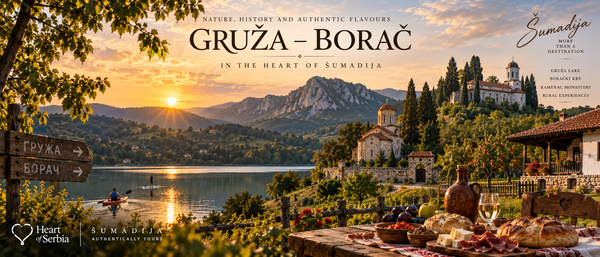
Nature, History and Authentic Flavours in the Heart of Šumadija
The thematic “Gruža–Borač” Route takes visitors through one of the most beautiful and authentic landscapes of Šumadija, bringing together natural attractions, cultural and historical heritage, outdoor activities and traditional gastronomy into a unique travel experience. Within a relatively small area, the scenery shifts from the peaceful shores of Gruža Lake and the impressive volcanic cliffs of Borački Krš to medieval heritage sites, rural households and places that still preserve the spirit o