
Grivac – A Prehistoric Town Beneath the Fields of Šumadija
At first glance, Grivac appears to be a peaceful Šumadija village, surrounded by gentle hills, fields and the quiet rhythm of everyday rural life. Yet beneath this seemingly ordinary landscape lies one of the most significant archaeological discoveries in this part of Europe — a Neolithic settlement that is changing the way we understand prehistory.
At the Grivac archaeological site, researchers have uncovered the remains of a settlement covering around 40 hectares. This was not simply a collection of houses, but an organised and carefully planned town dating back to the Vinča culture. Houses were arranged in regular rows, streets ran between them, and the entire settlement was protected by a ditch and palisade.
This is no longer a story about a prehistoric village.
It is the story of a town.
A Town Thousands of Years Old
Research has shown that more than 600 structures once stood at Grivac, pointing to a highly developed community with a population numbering several thousand people. At one point, this prehistoric town may even have had more inhabitants than Kragujevac did in the 19th century.
Such an organised way of life — planned construction, defensive systems and a clearly structured settlement — reveals the remarkable level of development achieved by the community that lived here thousands of years before the Common Era.
The Vinča culture, to which Grivac belongs, is regarded as one of the most advanced Neolithic cultures in Europe. Recent research at this very site continues to expand our knowledge of the period and challenge earlier assumptions about prehistoric societies.
Major Archaeological Discoveries at Grivac
Research Revealing a New Picture of the Past
Although the first archaeological work at Grivac began as early as the 1950s, it is only with the help of modern technology that researchers have been able to understand the true scale and importance of the site.
Today, cooperation between the Institute for the Protection of Cultural Monuments in Kragujevac, the Institute of Archaeology in Belgrade and the University of Pittsburgh is opening an entirely new chapter in the research.
Geophysical surveys and other modern methods are revealing layers of history that remained hidden beneath the surface for decades.
Each new discovery further confirms that Grivac is one of the most important Neolithic sites in the region.
Nature Preserving History
What makes Grivac particularly remarkable is the contrast between its past and present.
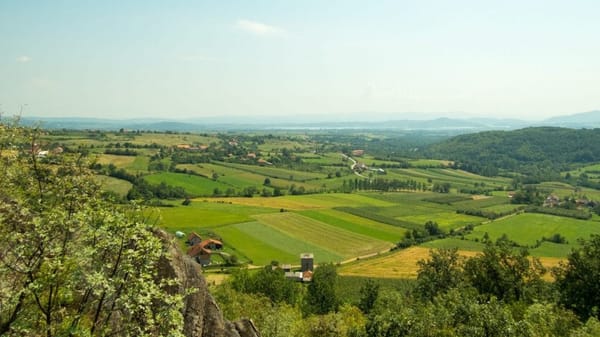
Beneath fields and meadows that are still cultivated today lie the traces of an ancient town.
The surrounding landscape is unmistakably Šumadijan — rolling hills, fields, orchards and a countryside that feels peaceful and gentle. It is precisely this simplicity that makes the knowledge of what lies beneath the ground even more striking.
This is a place where nature does not hide history.
It preserves it.
Grivac Today
Although the site has not yet been fully explored or developed as a conventional tourist attraction, its importance is already well recognised within the archaeological and scientific community.
In the future, Grivac has the potential to become one of Serbia’s most important archaeological and educational destinations.
For visitors looking for something different, it offers a rare opportunity to stand in a place where history lies quite literally beneath their feet.
Why Visit Grivac?
Because here, what you see above the ground is only part of the story.
Here, you are standing above a town that existed thousands of years before us — a place where people lived, built homes, planned their surroundings and created an organised community.
Grivac is not a conventional tourist destination.
It is a place whose full story is still waiting to be uncovered — yet even today, it leaves a powerful impression.
Contact & Information
📍 Location: Grivac village, Municipality of Knić, near Kragujevac
🏛 Type: Archaeological site — Neolithic settlement
🧭 Status: Currently under archaeological investigation
Autor
What's Next?

Stari Hrast Winery – Wine with a Sense of Place in Šumadija
Just fifteen kilometres from Kragujevac, on a plateau above the village of Žirovnica, lies one of those places that help explain why Šumadija has increasingly come to be recognised as one of Serbia’s most promising wine regions. Stari Hrast Winery is neither a large industrial producer nor does it aspire to become one. Its strength lies precisely in the opposite approach: a family estate, its own vineyards and orchards, clearly defined provenance and a close connection between the wine and the
Why Are We Still Ashamed of Our Culinary Heritage?
Šumadija has the products, the tradition and the culture of hospitality, but it still lacks a clear gastronomic direction capable of transforming its local cuisine into a serious tourism product. Šumadija does not have a problem with its culinary heritage. It has a problem with the way it relates to that heritage. This is perhaps the simplest way to describe the position in which one of Serbia’s richest gastronomic regions finds itself today. We have the products, the traditions, the climate an
Stara Srbija Tavern – More Than a Century of Kragujevac’s Kafana Tradition
In the very heart of Kragujevac, on Karađorđeva Street, stands a place that is far more than simply a restaurant. Stara Srbija belongs to that increasingly rare tradition of Serbian kafanas – places where history is not preserved only in old photographs and stories on the walls, but is still felt in conversations around the table, in the aroma of traditional food and in an atmosphere that recalls a time when the kafana was one of the most important institutions of urban life. The roots of Stara
In the Footsteps of Karađorđe – A Journey Through Serbian History, Heritage and Identity
Set out through the heart of Šumadija on a journey connecting some of the most important chapters in Serbian history – from the First Serbian Uprising to the rise of modern Serbia under the Karađorđević dynasty. The thematic route “In the Footsteps of Karađorđe” connects Viševac, Orašac, Topola and Aranđelovac, creating a journey through the places where the foundations of modern Serbian statehood were laid. From Karađorđe’s birthplace in Viševac, through revolutionary Orašac, where the uprisin