

Lapovo – A Place Where Trains Set the Rhythm
On this page
In the heart of Šumadija, between Kragujevac, Jagodina and Velika Plana, lies Lapovo — a small town with a big story. At first glance, it seems quiet and unassuming, yet its history connects it with some of the most important currents in the development of Serbia — and even Europe.
Lapovo is one of those towns whose significance cannot be measured by population alone, but by the story it carries.
Set in the plains of Šumadija, near the Velika Morava River, it was for centuries a place people passed through. But with the arrival of the railway, Lapovo became a place people remembered.
Its roots reach deep into the past, and historical records mention the settlement as early as the Middle Ages. The true turning point, however, came at the end of the 19th century, when the construction of the Belgrade–Niš railway in 1884 changed the town’s destiny.
From that moment on, Lapovo grew into one of Serbia’s most important railway junctions.
The tracks did more than cut across the landscape.
They opened a gateway to the world.
When Europe Passed Through Lapovo
Just a year later, in 1885, the legendary Orient Express began passing through Lapovo — the famous train linking Paris with Constantinople and symbolising luxury, travel and prestige.
At a time when railways represented the height of modernity and every long journey was an adventure, Lapovo found itself on one of the world’s most important routes.
Diplomats, merchants, artists and travellers from distant parts of Europe passed through its station.
Imagining that scene today helps us understand just how important this small town once was: the darkness of the night, the lights glowing from the carriages, the sound of the locomotive and the brief stop of a train connecting different parts of a continent.
In those moments, Lapovo was not simply a small provincial town.
It was part of Europe.
A Town That Grew Along the Tracks
During the 20th century, Lapovo developed into one of the country’s key railway hubs.
Its marshalling yard expanded, the network of tracks grew, and the town itself began to live according to the rhythm of arriving and departing trains.
The railway here was never merely a source of employment.
It became part of the town’s identity.
Generations of local families worked on the railway, while the station became one of the focal points of everyday life. Every arrival and every departure had its own story.
Even today, although the rhythm is quieter than it once was, Lapovo still preserves that spirit. Its railway infrastructure, open spaces and atmosphere remain reminders of a period when this town was an important point on the European transport map.
Lapovo Today – Between Travel, Memory and Art
Today, Lapovo lies directly on the Belgrade–Niš motorway, further confirming its long-standing role as an important transport junction.
Yet its real value lies not only in its practical function, but in the different layers of history and memory that have accumulated here.
It is a place where past and present can still be felt side by side — where the calm of an ordinary day conceals echoes of journeys that once connected cities, countries and people.
For generations, many residents of the Municipality of Lapovo have lived and worked around the railway. It is a tradition that continues to shape the town even today.
In recognition of this deep connection, the Municipal Assembly declared Lapovo a “Railway Museum Town” in 2005.
Since then, locomotives and other railway exhibits have been displayed at several locations throughout the town, while illuminated installations and displays highlight the inseparable bond between Lapovo and the railway.
Two years later, in 2007, the town launched the international exhibition “Railway Museum Town”, originally conceived as an opportunity for railway workers who were also artists to present their work.
Today, artists who respond to the public call can participate in three categories: painting, sculpture and photography.
The event has developed a regional character and attracts an increasing number of participants from abroad each year.
What to See and Experience in Lapovo
Lapovo is not a destination defined by conventional tourist attractions.
Instead, it is discovered through atmosphere and the stories embedded in the town itself.
A walk through Lapovo naturally leads towards the railway station — the place that still preserves the spirit of the era when some of the world’s most famous trains passed through here.
The tracks, old railway buildings and surrounding area provide an authentic glimpse into the character of a true “railway town”.
Nearby stands the Church of St. Petka, a peaceful and modest place that offers a completely different rhythm — a contrast to the town’s history of speed, movement and constant departures.
For a break from the urban surroundings, visitors can head towards the banks of the Velika Morava River, where nature restores a sense of balance and offers another perspective on the area.
Lapovo is an ideal place for a short stop — somewhere to pause and imagine what it must once have felt like to watch the Orient Express pass through the heart of Šumadija.
Why Visit Lapovo?
Because it is one of those rare places where a small town carries a remarkably large story.
You do not come here for spectacle.
You come for the feeling — for that moment when you realise you are standing at a station through which Europe once passed.
And in that moment, Lapovo stops being merely a place along the way.
It becomes an experience.
Contact & Information
📍 Location: Lapovo, Šumadija District
🚗 Access: Belgrade–Niš motorway (A1), Lapovo exit
🚆 Railway: Main Belgrade–Niš railway line
🏛 Municipality of Lapovo
📞 Phone: +381 34 853 030
🌐 Website: www.lapovo.ls.gov.rs
Autor
On this page
What's Next?

Stari Hrast Winery – Wine with a Sense of Place in Šumadija
Just fifteen kilometres from Kragujevac, on a plateau above the village of Žirovnica, lies one of those places that help explain why Šumadija has increasingly come to be recognised as one of Serbia’s most promising wine regions. Stari Hrast Winery is neither a large industrial producer nor does it aspire to become one. Its strength lies precisely in the opposite approach: a family estate, its own vineyards and orchards, clearly defined provenance and a close connection between the wine and the
Why Are We Still Ashamed of Our Culinary Heritage?
Šumadija has the products, the tradition and the culture of hospitality, but it still lacks a clear gastronomic direction capable of transforming its local cuisine into a serious tourism product. Šumadija does not have a problem with its culinary heritage. It has a problem with the way it relates to that heritage. This is perhaps the simplest way to describe the position in which one of Serbia’s richest gastronomic regions finds itself today. We have the products, the traditions, the climate an
Stara Srbija Tavern – More Than a Century of Kragujevac’s Kafana Tradition
In the very heart of Kragujevac, on Karađorđeva Street, stands a place that is far more than simply a restaurant. Stara Srbija belongs to that increasingly rare tradition of Serbian kafanas – places where history is not preserved only in old photographs and stories on the walls, but is still felt in conversations around the table, in the aroma of traditional food and in an atmosphere that recalls a time when the kafana was one of the most important institutions of urban life. The roots of Stara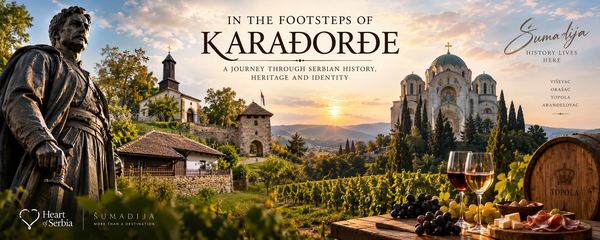
In the Footsteps of Karađorđe – A Journey Through Serbian History, Heritage and Identity
Set out through the heart of Šumadija on a journey connecting some of the most important chapters in Serbian history – from the First Serbian Uprising to the rise of modern Serbia under the Karađorđević dynasty. The thematic route “In the Footsteps of Karađorđe” connects Viševac, Orašac, Topola and Aranđelovac, creating a journey through the places where the foundations of modern Serbian statehood were laid. From Karađorđe’s birthplace in Viševac, through revolutionary Orašac, where the uprisin